
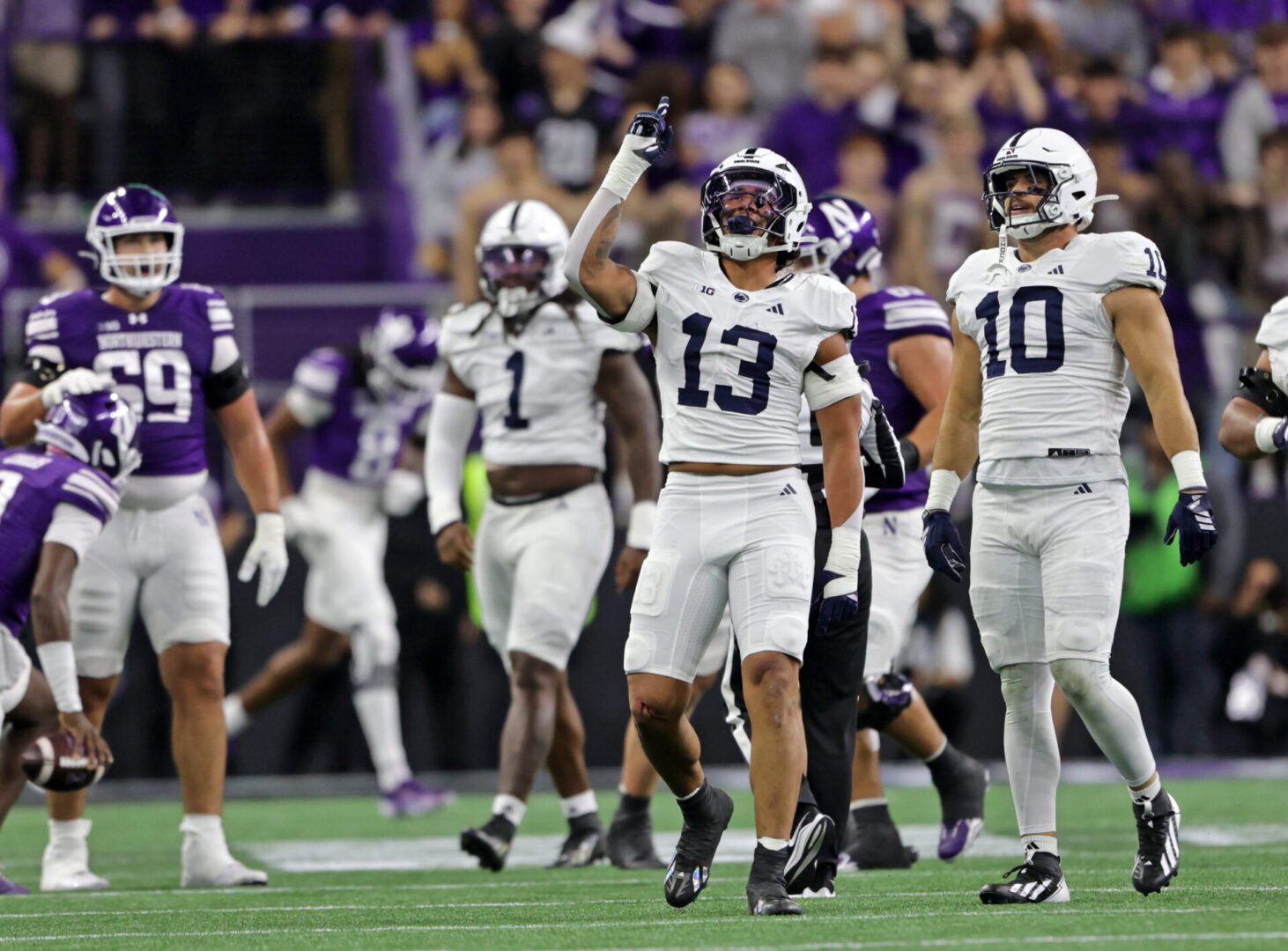
Matt Campbell uttered the same three words again and again and again on Tuesday in his press conference in Beaver Stadium — where he and his Nittany Lions return on Saturday night for a White Out contest against No. 19 USC.
The Campbell Word Counter, from his detailed review and final rehash of the Nittany Lions’ 34-13 loss at Northwestern:
Consistent/Inconsistent: 17
Identity: 8
Campbell, now 3-2 in his brief career as Penn State’s head coach, was painstakingly consistent in emphasizing how inconsistent the Nittany Lions have been in two consecutive losses to open the Big Ten Conference season, and how they have lacked a cohesive identity, especially on offense. In a nutshell, here’s what Campbell had to say about each:
IDENTITY: “The reality of it is, we lack an identity. We lack who we want to be and where we need to be. …When that’s not working, it certainly stresses the entire organism.
“Obviously, that is frustrating. It goes back to the identity of our football team, or lack thereof right now, of having the identity we want to have and expect to have. We have to work really hard to get back right now.
“I think the reality of it is — it goes back to kind of what I’ve said this whole press conference — we lack our identity right now across the board offensively, defensively, and on special teams as to who we want to be and how we want to win football games.”
INCONSISTENCY: “I think the easy thing is to say is it a physical problem? Is it a lack of physicality? I think some of that shows up when you’re so inconsistent in some of the detailed things it takes to play good football really in all three phases.
“Again, if the work is inconsistent across the board, then we have to make sure that our fundamental and technique back to simplicity equals velocity.
“The lack of consistency around Rocco [Becht, the quarterback] is certainly putting the spotlight on Rocco’s ability or inability and ties to play with consistency as well. I think the biggest thing is that goes to a global approach to this as well — we have to do a better job of having consistency of those other 10 players so we can get him into a rhythm so he can play with great consistency. And we haven’t been able to do that.”
IT’S A PEOPLE THING
The solution? Better play from his human beings: “I have great belief in the humans,” Campbell said. I think the first thing is do you have the right people? And we do in that room. We’ve got great coaches. We’ve got great players.”
To start the season, Penn State outscored or tied its opponent in each of its first 15 quarters. (Ties: Buffalo 7-7, fourth quarter; Wisconsin, 3-3, third quarter). Then, the wheels came off.
The last five quarters — a cumulative 48-13 freefall by Penn State — has fans questioning Campbell. And Campbell himself questioning who his team is. He means the style of play. But who the players are, where they came from, and how they have merged into cohesive and successful units on the field — and not just in the locker room — is paramount when you are trying to win football games.
Campbell saw this coming. He spent a good bit of the offseason trying to merge two distinct families, which were originally located 901 miles apart — the distance from Ames, Iowa to State College, Pa. — in one unit tied together by trust, shared experience and values, family, legacy and history.
He did a crash course on team-building. He brought in Penn State letterman after letterman. Had Sue Paterno talk to the squad. Took the team on a camping retreat, where they slept in cabins. Set up numerous community service outings to ground players and foster perspective. Then finished summer camp with Victory Day in Beaver Stadium, supporting children and families with challenges.
All the while, Campbell knew his biggest challenge might be getting Yours, Mine and Ours to not just survive and “grow forward” — one of his favorite phrases — but to strive and then thrive on the playing field.
That was and remains the biggest task for his core 13-man coaching staff — which includes Campbell and his strength and conditioning coach, Reid Kagy. Of that group, seven (54%) were at Iowa State last season and three (23%) are Penn Staters: associate head Terry Smith, 3-3 in 2025 as PSU’s interim head coach; special teams coach Justin Lustig, and D-coordinator D’Anton Lynn, who was at USC last season, but was a standout player at Penn State, starting 37 of his last 38 games. That 77% of Iowa State/Penn State closely mirrors the percentage of the 2026 team’s starters as well.
THEIR ROOTS, FOR STARTERS
I analyzed the starting lineup for Penn State’s first five games, including the offense, defense, place-kicker and punter. And what I found is what you know: It is mostly comprised of players from Penn State and Iowa State — 81.7%, in fact. Not a surprise.
In that sense, the identity (i.e., roots) of the team is not as discombobulated as you might think. Hence, the nicknames like Iowa State East and Nittany Cyclones. Here’s a breakdown:
OFFENSE (55 starts total) — The Penn State starters are all along the line: O-linemen Malachi Goodman, Cooper Cousins and Anthony Donkoh, and tight end Andrew Rappleyea. Center Brock Riker played last season at Texas State. And running back James Peoples, who started the Northwestern game, was at Ohio State in 2025. The remaining offensive starters all came from Iowa State. Offensive roots are:
Iowa State – 29 starts (53%)
Penn State – 20 starts (36%)
Others — 6 starts (11%)
DEFENSE (55 starts total) — UCLA is the outlier here, but significant. Defensive tackles Keanu Williams and Siale Taupaki played together at UCLA from 2023-25, and were coached there by current PSU DT/running game coach Ikaika Malloe. So, when the Nittany Lions got gashed up the middle at Northwestern, it was this UCLA trio who were literally in the middle of it…and couldn’t stop it. D-end Alexander McPherson, with one start, was at Colorado in 2025. And I count true freshman Josiah Zayas as a Penn State roots guy. Defensive roots are:
Penn State — 25 starts (45.5%)
Iowa State — 19 starts (34.5%)
UCLA — 10 starts (18.2%)
Colorado — 1 start (1.8%)
SPECIALISTS (10 starts total) — ST roots are:
Penn State/Ryan Barker (PK) — 5 starts (50%)
Mississippi State/Nathan Tiyce (P) – 5 starts (50%)
STARTERS (124 starts)— Roots:
Iowa State — 48 starts (40%)
Penn State — 50 starts (41.7%)
UCLA — 10 starts (8.3%)
Others — 12 starts (10%)
A .600 RECORD
Maybe, after all that, the 2026 Nittany Lions — no matter where they came from — are not all that great. Maybe Bill Parcells was right: “You are what your record says you are.”
Because when you do the math, a 3-2 record (a winning percentage of .600) at this point should not be that big of a surprise. In 2025, Penn State was 7-6 and Iowa State was 8-4. Many of those pieces ended up — or stayed — in State College for the 2026 season. But not all of them, that’s for sure. Together, the two records equal 15-10. In other words, a winning percentage of .600. And, for now, that’s their identity.
More Penn State Football
View all Penn State Football
D’Anton Lynn Prepares Penn State Defense for Familiar Challenge Against USC
Penn State’s defense will likely face its toughest task yet against a high-powered USC offense on Saturday inside Beaver Stadium. Defensive coordinator D’Anton Lynn is preparing to face off against […]
Big Ten Announces Kickoff Time for Penn State at Michigan
Penn State and Michigan won’t be receiving prime-time treatment this season. The Nittany Lions’ battle against the Wolverines on Oct. 17 will kick off at 3:30 p.m. EDT, the Big […]
Penn State’s Chase Sowell Expresses Belief in Rocco Becht After Northwestern Loss
As the final seconds ticked away inside Northwestern’s freshly minted Ryan Field on Friday night, the high expectations that accompanied Penn State into the 2026 season continued to unravel. A […]


